
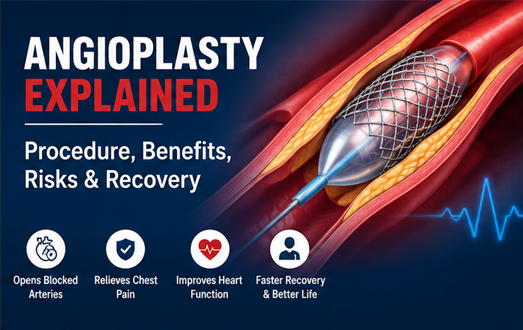
Angioplasty Explained: Procedure, Benefits, Risks & Recovery
Coronary angioplasty, also known as percutaneous coronary intervention (PCI), is a minimally invasive procedure used to improve blood flow through narrowed or blocked coronary arteries. It is commonly performed for patients with coronary artery disease and may also be used as an emergency treatment during certain heart attacks.
For patients and families, understanding what angioplasty involves, why it may be recommended, its benefits and possible risks, and what recovery looks like can make the treatment journey less stressful.
Dr. Vaibhav Mishra, Interventional Cardiologist in Varanasi, specializes in coronary interventions and has experience with angioplasty, including complex CTO and bifurcation interventions.
What Is Coronary Angioplasty?
Coronary angioplasty is a procedure performed to open a narrowed or blocked coronary artery and improve blood flow to the heart muscle.
During the procedure, a cardiologist guides a thin catheter through an artery, commonly from the wrist or groin, toward the coronary arteries. A small balloon is positioned at the site of narrowing and inflated to widen the artery. In most modern procedures, a stent is also placed to help keep the artery open.
A stent is a small mesh tube that acts as a scaffold inside the artery. Drug-eluting stents, which release medication, are commonly used to reduce the risk of the artery narrowing again.
Why Is Angioplasty Needed?
Coronary arteries can become narrowed because of atherosclerosis, where plaque builds up inside the blood vessels. Reduced blood flow to the heart may cause symptoms such as chest pain or angina.
Depending on the severity and location of the blockage, a cardiologist may recommend medication, angioplasty, bypass surgery, or another treatment approach. Angioplasty may be considered when a significant blockage is causing symptoms or when urgent restoration of blood flow is needed.
Angioplasty is also frequently used as an emergency treatment after a heart attack when appropriate.
Who May Need Angioplasty?
Angioplasty may be considered for patients with:
- Significant coronary artery narrowing
- Coronary artery disease
- Angina or recurring chest discomfort
- Certain heart attacks
- Reduced blood flow caused by coronary artery blockage
- Blockages that require revascularization
However, not every blockage requires angioplasty. The appropriate treatment depends on factors such as symptoms, the location and severity of the blockage, overall health, heart function, and findings from cardiac investigations.
A cardiologist evaluates these factors before recommending a treatment plan.
How Is Angioplasty Performed?
1. Pre-Procedure Evaluation
Before angioplasty, the cardiology team evaluates the patient's overall health and cardiac condition. Blood tests and other investigations may be performed, and coronary angiography may be used to identify the location and severity of blockages.
Your doctor will also review your medications, allergies, medical history, and other conditions before the procedure.
2. Local Anaesthesian
Angioplasty is generally performed under local anaesthesia. The patient is usually awake during the procedure, although medication may be given to help with relaxation when appropriate.
3. Catheter Placement
A small tube called a sheath is inserted into an artery, commonly through the wrist or groin. A thin catheter is then guided through the blood vessel toward the coronary arteries using X-ray imaging.
4. Opening the Blockage
A thin guidewire is carefully passed across the narrowed area. A small balloon is then positioned at the blockage and inflated to widen the artery and improve blood flow.
5. Stent Placement
In many cases, a stent is positioned at the treated area. When expanded, it helps support the artery and maintain blood flow.
The stent remains permanently inside the artery.
6. Completion of the Procedure
Once the artery has been treated and blood flow has improved, the balloon and catheter are removed. The access site is then managed to prevent bleeding.
The procedure commonly takes around 30 minutes to 2 hours, although complex cases may take longer.
Benefits of Angioplasty
When appropriately recommended, coronary angioplasty can provide several important benefits.
Improved Blood Flow
Opening a narrowed coronary artery can improve blood flow to the heart muscle.
Relief from Angina
Many patients experience improvement in chest pain and other symptoms related to reduced coronary blood flow after successful treatment.
Minimally Invasive Treatment
Unlike coronary bypass surgery, angioplasty does not require a large surgical incision. It is performed through a small access point in an artery.
Emergency Heart Attack Treatment
In appropriate heart attack situations, emergency angioplasty can restore blood flow to the heart and may improve outcomes.
What Are the Risks of Angioplasty?
Although coronary angioplasty is commonly performed and serious complications are generally uncommon, it is still an invasive medical procedure and carries potential risks.
Possible complications include:
- Bleeding or bruising at the catheter insertion site
- Blood vessel damage
- Reaction to the contrast material
- Kidney problems related to contrast in susceptible patients
- Damage to a coronary artery
- Blood clot formation within a stent
- Heart attack
- Stroke
- Rarely, life-threatening complications
The individual risk depends on factors such as age, general health, severity of coronary disease, whether the procedure is planned or performed during an emergency, and other medical conditions. Your cardiologist should explain your individual risks before treatment.
What Happens After Angioplasty?
After the procedure, the medical team monitors your heart rate, blood pressure, access site, and overall condition.
Depending on the complexity of the procedure and your clinical condition, you may be able to go home the same day or may need an overnight or longer hospital stay.
Some bruising, tenderness, or mild discomfort around the catheter insertion site can occur and usually improves during recovery.
Angioplasty Recovery
Recovery varies from person to person.
For an uncomplicated planned angioplasty, many patients can gradually return to normal activities relatively quickly. Your cardiologist will provide specific instructions regarding exercise, driving, work, wound care, and other activities.
Heavy lifting and strenuous activity may need to be avoided temporarily while the access site heals.
Patients who undergo emergency angioplasty following a heart attack may require a longer recovery period.
Medicines After Angioplasty
If a stent has been implanted, your cardiologist will usually prescribe medicines to reduce the risk of blood clots forming inside the stent.
These may include antiplatelet medicines, such as aspirin combined with another antiplatelet drug, depending on your individual circumstances.
Do not stop prescribed antiplatelet or other cardiac medicines on your own. Stopping certain medicines prematurely can increase the risk of complications, including stent thrombosis. Always discuss medication changes with your treating cardiologist.
Lifestyle After Angioplasty
Angioplasty treats a blockage, but it does not remove the underlying tendency to develop coronary artery disease.
Long-term heart health may require:
- Stopping tobacco use
- Maintaining a healthy weight
- Following a heart-healthy diet
- Regular physical activity as advised by your doctor
- Controlling blood pressure
- Managing diabetes
- Managing cholesterol
- Taking prescribed medicines regularly
- Attending follow-up appointments
- Participating in cardiac rehabilitation when recommended
Cardiac rehabilitation can support recovery through supervised exercise, education, lifestyle guidance, and risk-factor management.
Angioplasty vs Bypass Surgery
Angioplasty and coronary artery bypass grafting (CABG) are different approaches to restoring blood flow to the heart.
Angioplasty is minimally invasive and uses a catheter, balloon, and usually a stent. Bypass surgery creates a new route around blocked coronary arteries using a blood vessel graft.
For patients with extensive or complex coronary disease, CABG may sometimes be considered instead of angioplasty. The choice depends on the patient's anatomy, symptoms, overall health, and clinical circumstances.
Your cardiologist can discuss which treatment is most appropriate for your specific condition.
When Should You Contact Your Doctor After Angioplasty?
Contact your medical team if you develop concerning symptoms such as:
- Increasing pain or swelling at the catheter site
- Redness or discharge from the wound
- Fever
- Persistent or worsening symptoms
Seek urgent emergency medical attention for severe or persistent chest pain, significant bleeding that does not stop with pressure, or sudden coldness, numbness, or discoloration of the arm or leg used for the procedure.
Angioplasty Treatment in Varanasi
Dr. Vaibhav Mishra is an Interventional Cardiologist in Varanasi with specialized training in cardiology and experience in coronary interventions.
His interventional expertise includes coronary angiography, coronary angioplasty, complex coronary interventions, CTO interventions, bifurcation procedures, and pacemaker implantation. He has performed more than 1,000 angioplasties, including complex CTO and bifurcation interventions.
His approach focuses on careful evaluation, appropriate treatment planning, and personalized cardiac care for every patient.
Conclusion
Coronary angioplasty is an important treatment for selected patients with narrowed or blocked coronary arteries. By improving blood flow, it can relieve symptoms and, in appropriate emergency situations, play a critical role in restoring blood supply to the heart.
However, angioplasty is not the right treatment for every patient. A detailed evaluation by an experienced cardiologist is essential to determine whether angioplasty, medication, bypass surgery, or another treatment is appropriate.
If you have persistent chest pain, breathlessness, or other concerning symptoms, seek medical evaluation promptly.
Book a Cardiology Consultation in Varanasi
For evaluation of coronary artery disease and discussion of angioplasty or other cardiac treatment options, consult Dr. Vaibhav Mishra, Interventional Cardiologist in Varanasi.
Disclaimer: This article is intended for general health education and does not replace a medical consultation, diagnosis, or individualized treatment plan. Angioplasty should only be undertaken when recommended by a qualified cardiologist after appropriate evaluation.