
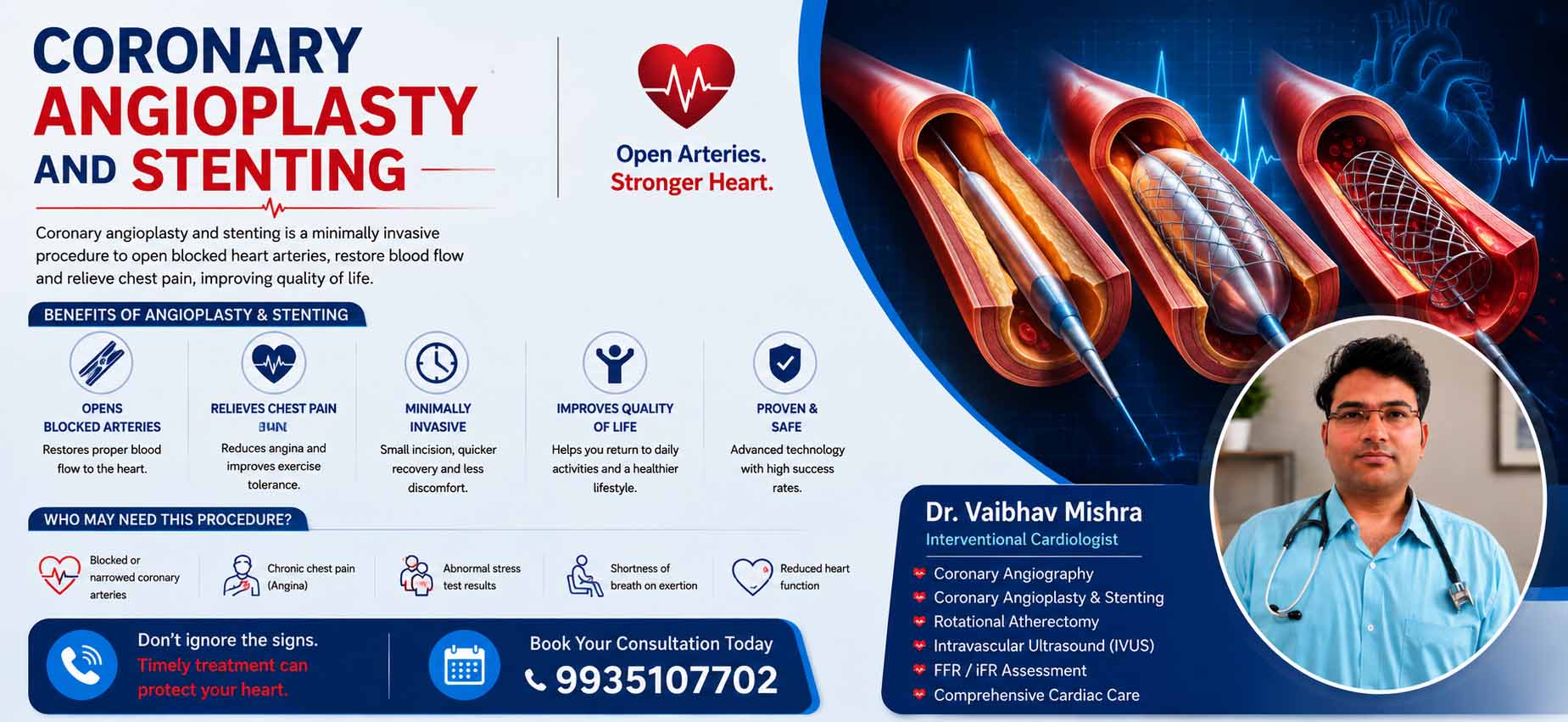
Coronary Angioplasty and Stenting
Coronary angioplasty and stenting, also known as Percutaneous Coronary Intervention (PCI), is a minimally invasive procedure used to improve blood flow through narrowed or blocked coronary arteries. It may be recommended for selected patients with coronary artery disease, significant coronary blockages, or certain acute coronary syndromes.
What Is Coronary Angioplasty?
When plaque builds up inside the coronary arteries, the arteries can become narrowed and restrict blood flow to the heart muscle. During angioplasty, a thin catheter is guided to the narrowed portion of the artery. A small balloon is then inflated to widen the artery and improve blood flow.
In many cases, a stent is placed at the treated area. A stent is a small mesh tube that expands inside the artery and helps keep it open after the balloon is removed.
When Is Angioplasty Recommended?
Depending on the patient's symptoms, coronary anatomy, clinical condition, and overall cardiovascular risk, angioplasty may be considered for:
- Significant coronary artery blockages
- Coronary artery disease causing angina
- Certain acute coronary syndromes and heart attacks
- Narrowed arteries affecting blood flow to the heart
- Selected complex coronary artery disease
- Patients requiring revascularization after appropriate cardiac evaluation
Not every coronary blockage requires angioplasty. Treatment decisions should be individualized based on the patient's condition and the location and complexity of the coronary disease.
How Is the Procedure Performed?
Coronary angioplasty is generally performed in a cardiac catheterization laboratory.
- Access to the artery: A catheter is introduced through an artery, commonly through the wrist or groin.
- Guiding the catheter: The catheter is carefully guided toward the coronary arteries using specialized X-ray imaging.
- Crossing the blockage: A thin guidewire is passed through the narrowed section.
- Balloon angioplasty: A small balloon is positioned across the blockage and inflated to widen the artery.
- Stent placement: When appropriate, a stent is expanded at the treated site to help maintain the artery's opening.
- Completion: The balloon and catheter are removed while the stent remains in position.
Benefits of Coronary Angioplasty and Stenting
When appropriately indicated, PCI can:
- Improve blood flow through a narrowed coronary artery
- Relieve symptoms such as angina in suitable patients
- Restore blood flow during certain heart attacks
- Avoid the need for open-heart surgery in selected cases
- Provide a minimally invasive approach to coronary revascularization
The specific benefits depend on the patient's condition and the reason for performing the procedure.
Complex Coronary Angioplasty
Some coronary blockages are more technically challenging to treat. These may include chronic total occlusions (CTO) and bifurcation lesions.
Dr. Vaibhav Mishra has experience in advanced coronary interventions, including CTO and bifurcation angioplasty, and has performed more than 1,000 angioplasties during his interventional cardiology journey.
What Happens After Stenting?
Following angioplasty, patients are monitored for bleeding, discomfort, and other potential complications. Depending on the procedure and the patient's condition, hospital observation may be required.
Patients with a coronary stent are commonly prescribed antiplatelet medication to reduce the risk of a blood clot forming inside the stent. It is extremely important to take these medicines exactly as prescribed and not stop them without consulting the treating cardiologist.
Recovery varies between individuals. Many patients can gradually return to normal activities within days, depending on their procedure and medical condition.
Why Follow-Up Care Matters
Angioplasty treats a specific coronary blockage, but it does not eliminate the underlying risk factors for coronary artery disease.
Long-term heart health may involve:
- Taking prescribed medicines regularly
- Managing blood pressure and cholesterol
- Controlling diabetes
- Following a heart-healthy diet
- Avoiding tobacco
- Maintaining appropriate physical activity
- Attending cardiology follow-ups
- Participating in cardiac rehabilitation when recommended
Cardiac rehabilitation can be appropriate after coronary angioplasty or stenting and can support exercise, risk-factor management, education, and recovery.
Coronary Angioplasty in Varanasi
Dr. Vaibhav Mishra, Interventional Cardiologist in Varanasi, has specialized training in cardiology and extensive experience in coronary interventions. His expertise includes coronary angiography, angioplasty, complex coronary interventions, CTO procedures, bifurcation interventions, and pacemaker implantation.
With experience of more than 1,000 angioplasties, including complex CTO and bifurcation procedures, Dr. Mishra focuses on careful evaluation and individualized treatment planning for patients with coronary artery disease.
Take the Next Step Towards Better Heart Health
If you have recurrent chest discomfort, breathlessness, or have been diagnosed with a coronary artery blockage, consult an experienced cardiologist to understand your treatment options.